
Panelboard Primer
Every circuit in the house starts in one grey box. Here is what is inside it, in the order the power meets each part.
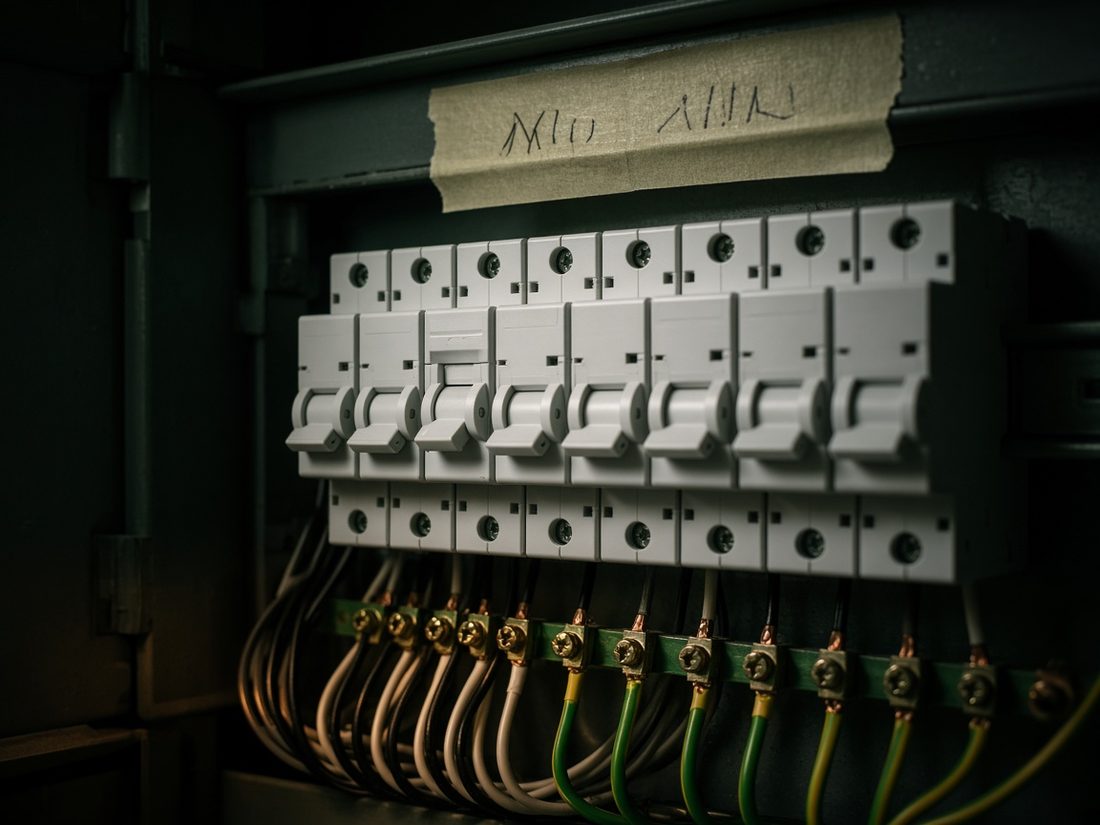
Before you look: removing the inner cover (the dead front) exposes live parts. The incoming conductors and the line side of the main breaker stay energised even when the main is switched off. Read this page with the cover on.
The parts, in the order power meets them
- Service entrance and main breaker. The utility’s conductors come from the meter into the main breaker. Switching it off disconnects every branch circuit downstream, which is why it is the first thing to find and label.
- Bus bars. Metal bars carry power from the main to the branch breakers. In a DIN-rail enclosure the same job is done by a comb busbar clipped across the breakers.
- Branch breakers. Each one protects a single circuit: a set of lights, a run of outlets, one aircon. Its rating, in amperes, is chosen for the wire it protects.
- Neutral bar. Where the supply includes a neutral, the returning conductors land here.
- Grounding bar. Green or green-yellow equipment grounding conductors bond metal boxes and appliance frames together and to the grounding electrode, so a fault has a safe path that trips the breaker.
- The directory card. The paper inside the door. If it is blank or wrong, the panel is much harder to use safely in an emergency.
Two lines, not one hot and one neutral
Many Philippine homes are fed with 230 V measured between two line conductors. In that arrangement neither wire at an outlet is a true neutral, so both can carry voltage. A single-pole switch or breaker on such a circuit interrupts only one of them, leaving the other live.
This is why two-pole breakers, which open both lines at once, are so common in local panels. Other installations are supplied with a line and a neutral instead. Which one you have depends on your utility and on how the house was wired, so ask a licensed electrician to confirm it rather than guessing from wire colours.
Breaker types you may see
| Type | Where you see it | What it responds to |
|---|---|---|
| Miniature circuit breaker (MCB) | Newer DIN-rail enclosures | Overload and short circuit |
| Plug-in or bolt-on breaker | Many older panelboards | Overload and short circuit |
| RCD / RCCB | Beside MCBs, often protecting wet areas | Current leaking to earth |
| RCBO | One device per circuit | Overload, short circuit and earth leakage together |
A replacement breaker has to suit the panel it goes into. Mixing devices that were never meant to fit a given bus is a common cause of loose, overheating connections.
Reading a trip
A trip after several minutes usually means overload: too many appliances on one circuit, often an aircon, a flat iron and a rice cooker together. An instant trip, sometimes with a snap, points to a short circuit. A residual-current device that trips has detected current leaking to earth, a warning sign in bathrooms, kitchens and outdoor outlets.
Unplug what was running on that circuit, then switch the breaker fully off and back on once. If it trips again straight away with nothing plugged in, leave it off. A breaker that is hot to the touch, buzzes, or comes with a burning smell is a reason to switch off the main if you can do so safely and call a licensed electrician.
Keep a directory you can read in the dark
Switch circuits off one at a time, walk the house, and write down what went dark. A good directory names rooms and big loads, not just “lights” and “outlets”.
| No. | Circuit | Serves |
|---|---|---|
| 1 | Lighting | Living room, dining, stairs |
| 2 | Outlets | Kitchen counter, refrigerator |
| 3 | Aircon | Main bedroom split unit |
| 4 | Water heater | Upstairs bathroom |
The table is an example layout, not a wiring plan. Keep a flashlight beside the panel and a photo of the directory on your phone.