
Wire & Breaker Sizing
A breaker protects the wire behind the wall, not the appliance plugged into it. Size the two together and most tripping problems explain themselves.
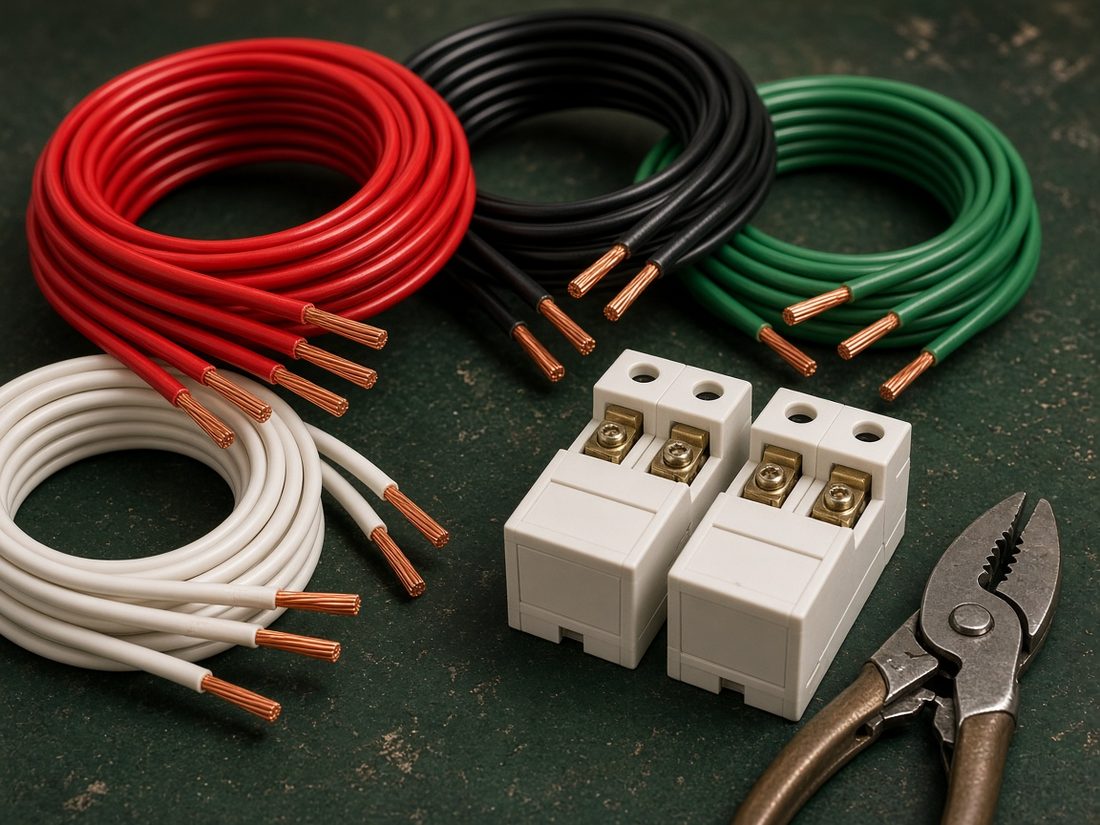
How wire size is written
Philippine plans and hardware stores usually quote copper building wire in square millimetres: 2.0, 3.5, 5.5, 8.0, 14, 22 mm² and up. Older installations and some imported cable use American Wire Gauge, where a smaller number means a thicker wire. Roughly, 2.0 mm² sits near 14 AWG, 3.5 mm² near 12 AWG, 5.5 mm² near 10 AWG and 8.0 mm² near 8 AWG.
The jacket also tells you the insulation type, often THHN or THWN for wire pulled through conduit. Insulation rating matters because it sets how hot the conductor may run, and so how much current it may carry.
Typical residential pairings
| Copper wire | Breaker often paired | Common use |
|---|---|---|
| 2.0 mm² | 15 A | Lighting circuits |
| 3.5 mm² | 20 A | General-purpose outlets |
| 5.5 mm² | 30 A | Aircon or water heater on its own circuit |
| 8.0 mm² | 40 A | Electric range or larger aircon |
These are starting points often seen on Philippine residential plans, not a design. The final size comes from the ampacity tables of the Philippine Electrical Code, the insulation rating, ambient temperature, how many conductors share the conduit, the run length and the equipment nameplate. The plan signed by a licensed electrical practitioner governs.
The arithmetic behind a circuit
Power in watts is roughly volts times amperes. At 230 V, a 20 A circuit can in theory carry about 4,600 W. Loads that run for hours, such as aircon, are commonly kept to around 80 percent of the breaker rating, which brings that figure to about 3,700 W, before you allow for the starting surge of a compressor.
Add up the nameplate watts of what actually runs together on one circuit. If the total is close to the limit, the answer is another circuit, not a bigger breaker.
Long runs and voltage drop
Every metre of wire costs a little voltage. On a long run to a garage, a rooftop pump or a second house on the lot, a size that is fine for current can still deliver low voltage at the far end, making motors run hot and lights dim. Designers often keep branch-circuit drop to a few percent; on long runs that can mean going up a wire size.
Why a bigger breaker is never the fix
Swapping a tripping 20 A breaker for a 30 A one on 3.5 mm² wire stops the trips by letting the cable carry more current than it was chosen for. The insulation inside the wall then heats instead. A breaker that trips is doing its job; the fix is to reduce the load, split the circuit, or have a new one installed.
Dedicated circuits
Split-type and window aircon, instant and storage water heaters, electric ranges, and pumps are usually given their own circuits so that their starting current and long run times do not overload a shared line. Check the appliance manual for the recommended breaker and wire size.
Genuine materials
Wires and breakers sold in the country fall under mandatory product certification by the DTI Bureau of Philippine Standards. Look for the PS or ICC mark on the product or packaging, buy from a shop that can show it, and be wary of cable that feels light for its stated size.